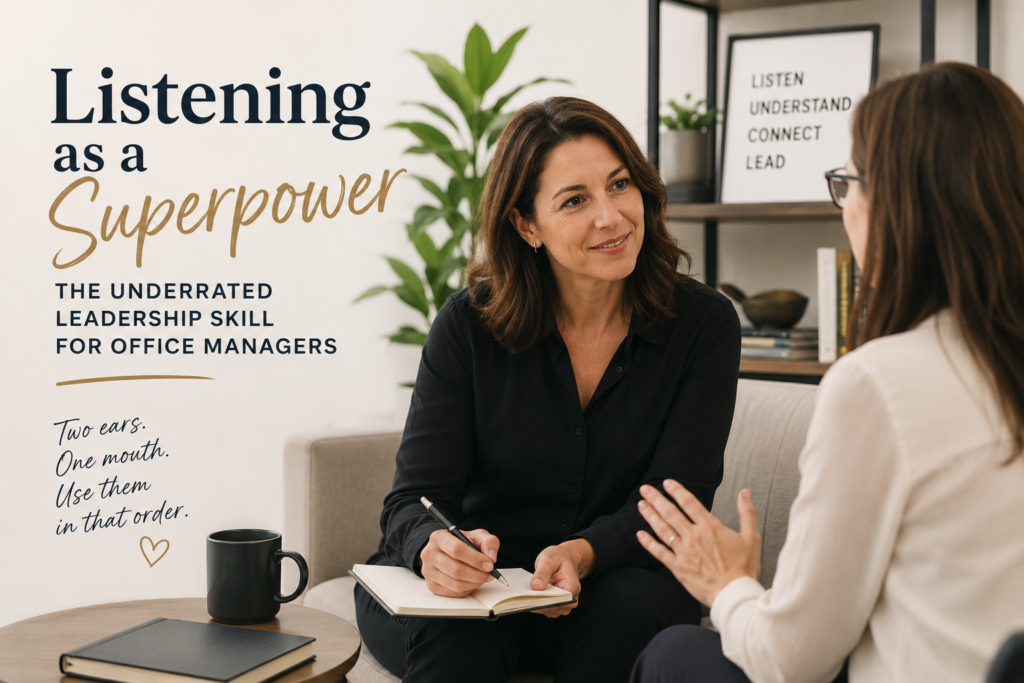
There’s a phrase I’ve found myself saying more and more over the years:
“Can I just ask one more question?”
Not because I haven’t been listening, but because I have.
It’s funny how your approach to work changes as you gain experience. Earlier in my career, I was desperate to prove myself. If someone came to me with a problem, I wanted to solve it quickly. If my manager asked me to organise something, I’d be halfway back to my desk before they’d even finished explaining it. I thought speed demonstrated competence.
What I’ve learnt over the years is that speed without understanding often creates more work than it saves.
As Office Managers, we spend our days in conversations. Some are planned, most aren’t. Someone catches you walking through reception because they’ve got a question. A supplier calls just as you’re about to head into a meeting. The CEO pops their head round the door with “have you got a minute?” – knowing full well it’s probably going to be twenty. Before lunch you’ve probably spoken to Finance, HR, IT, Facilities, a courier, a contractor and at least one person who’s simply needed a chat because you’re the person they trust.
When you think about it like that, it’s hardly surprising that listening becomes one of the most important skills we have. Not because we’re trained in it, but because our role gives us a front-row seat to almost everything happening in the business.
The challenge is that hearing and listening aren’t the same thing.
Most of us can hear instructions. We can write notes. We can nod in the right places. But active listening asks a little more of us. It asks us to be curious enough to understand what’s actually being said, rather than what we think we’ve heard.
I’ve lost count of the number of times someone has come to me asking for one thing, only for a couple of extra questions to uncover that they actually needed something completely different.
“I need another meeting room.”
Do you? Or do you actually need somewhere private because you’re dealing with a sensitive HR matter?
“The office is too noisy.”
Is it? Or are there simply not enough spaces where people can take Teams calls without disturbing everyone else?
“We need a bigger kitchen.”
Perhaps. Or perhaps people are all making coffee at exactly the same time because everyone’s travelling in on Tuesdays and Thursdays.
The more you listen, the more you start looking beyond the first answer.
I think that’s one of the reasons Office Managers naturally develop strong emotional intelligence. We work with so many different personalities that we begin to recognise when somebody is frustrated, overwhelmed, excited or anxious, often before they’ve actually said it. Sometimes it’s in their choice of words. Sometimes it’s their tone. Sometimes it’s what they don’t say.
That doesn’t mean we become counsellors or psychologists. It simply means we learn to read people a little better because our role depends on relationships.
One thing I wish I’d understood much earlier in my career is that asking questions doesn’t make you look inexperienced. If anything, it demonstrates the opposite. There is absolutely nothing wrong with saying, “Can I just check I’ve understood that correctly?” or “When you say you need this urgently, what deadline are we actually working towards?”
I’d much rather spend another two minutes clarifying a brief than another two hours redoing a piece of work because I’d made assumptions.
One of my favourite things about our Portal community is watching Office Managers help one another. Someone will ask a question expecting a quick answer, but instead they’ll often receive half a dozen thoughtful responses, each asking a slightly different question before offering advice. It’s a brilliant reminder that good listening isn’t just about hearing what’s being said – it’s about understanding the context before jumping to a solution.
It’s probably why I enjoy reviewing contracts as much as I do. I’m forever asking suppliers to explain something in plain English or to give me an example of how a clause would actually work in practice. The same principle applies whether you’re negotiating a managed print contract or organising the office Christmas party. Understanding first nearly always leads to better decisions.
Listening has also taught me something else over the years.
People don’t always remember exactly what you said to them, but they almost always remember how you made them feel.
If someone leaves a conversation feeling listened to, understood and respected, you’ve already strengthened that relationship. In a role like ours, where so much relies on trust and collaboration, that’s invaluable.
Perhaps that’s why Office Managers often become the unofficial sounding board in an organisation. We aren’t always the most senior person in the room, but we’re often the person people feel comfortable talking to. That’s a privilege, and one I don’t think we should underestimate.
As technology continues to evolve, there will be more systems to automate tasks, more AI to summarise meetings and more dashboards producing data than ever before. But none of those things can replace genuine human curiosity. They can’t ask a thoughtful follow-up question. They can’t notice the hesitation before someone answers. They can’t build trust over a conversation in the kitchen while the kettle boils.
People still do that.
And I suspect they always will.
So if you’re thinking about the skills you’d like to develop this year, don’t just think about the obvious ones. By all means learn a new system, improve your financial knowledge or take on a bigger project. But don’t overlook listening.
Because some of the best Office Managers I’ve ever worked with haven’t necessarily been the loudest people in the room.
They’ve simply been the ones who listened long enough to understand what everyone else had missed.