I use AI every single day.
There, I’ve said it.
And I don’t mean occasionally asking it to rewrite an email or having a play around with ChatGPT because everyone else is talking about it. AI has genuinely become another tool in my working day, in much the same way as Outlook, Excel, Teams, Canva or the various project management systems I’ve used over the years.
I also don’t think that’s something we should be embarrassed about or try to hide. If there’s a tool available that can help me get through some of the more time-consuming parts of my workload faster, give me a starting point when I’m staring at a blank page, or help me organise the 47 thoughts currently competing for attention in my head, I’m going to use it.
What I don’t do is ask AI to do my job for me.
There’s an important difference.
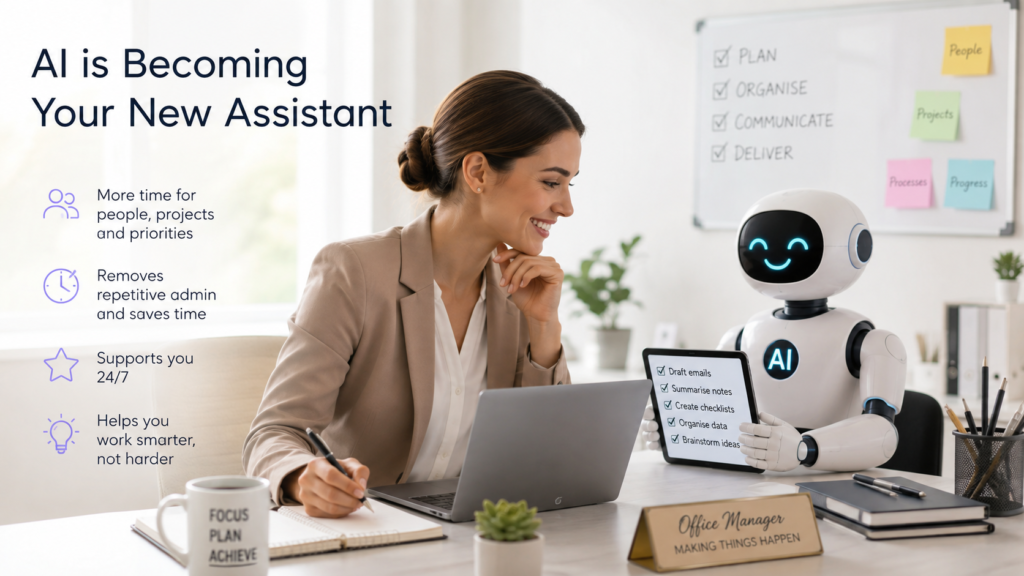
I’ve been talking about AI as part of the refresh of our Intermediate Office Management Course recently, and the way I’ve described it there is probably the simplest way I can explain how I see it: think of AI as another member of your team that’s available 24/7.
It’s an assistant, not the Office Manager.
For me, one of its biggest benefits is getting rid of the blank page. I might know exactly what I want a procedure to say, for example, but getting those thoughts out of my head and into a logical structure can take time. I can give AI the context, explain what I’m trying to achieve and ask it to create a first draft. I then review it, challenge it, change it, add the bits it couldn’t possibly know and turn it into something that’s actually mine.
The same goes for emails. Sometimes I’ll have written something and think, this sounds a bit sharp, or I’m waffling here, aren’t I? AI can help me tighten it up or look at the tone. Other times I’ll throw in a collection of notes and ask it to help me put them into some sort of sensible order before I start working on them properly.
I use it for brainstorming too. If I’m developing training, planning an event, creating a new Portal resource or thinking through a client problem, I’ll often use AI to bounce ideas around. Not because I expect it to produce the answer, but because having something to react to gets my own brain moving. Quite often I’ll disagree with what it suggests, but even that can be useful because it helps me clarify what I do think.
I’ve used it to help with Excel formulas, compare information, structure tender documents, create first drafts of policies and procedures, organise meeting notes, plan projects, proofread content and challenge whether I’ve missed something. There are probably dozens of small uses throughout my week that I barely even register as “using AI” anymore.
And I think that’s where it becomes really useful for Office Managers.
Think about the variety in our roles. You might be working on a supplier tender in the morning, writing an internal communication before lunch, reviewing a risk assessment in the afternoon and suddenly be asked to pull together an agenda for tomorrow’s leadership meeting. We constantly switch between completely different types of work, and a surprising amount of our time can disappear simply getting started.
If AI can take twenty minutes of staring at a blank document and turn it into two minutes of reviewing a sensible starting point, why wouldn’t we use it?
But – and this is a fairly substantial but – the output still belongs to you.
AI doesn’t know your organisation like you do. It doesn’t know that the CEO hates long emails, that Finance need something presented in a particular way, that the landlord has already rejected the suggestion it’s just confidently recommended, or that the supplier you’re dealing with has a history that changes how you need to approach the conversation.
It can also simply get things wrong.
That’s why I don’t think AI removes the need for knowledge. If anything, the better you understand your subject, the more useful AI becomes because you’re better equipped to spot when the answer isn’t right.
If you’re asking it to help draft a Health and Safety procedure, for example, you still need to understand Health and Safety. You need to check the legislation, make sure the controls are appropriate to your workplace and recognise if it’s produced something generic or inaccurate. Copying and pasting an AI-generated policy without reviewing it isn’t working smarter – it’s just outsourcing something you remain responsible for.
The same applies to confidentiality and data. Before putting company information into any AI tool, you need to understand what your organisation allows, which tools have been approved and what information you should and shouldn’t be sharing. People’s personal information, confidential commercial information, contracts and sensitive company data aren’t things to casually drop into a public AI tool because it makes the task quicker.
There is also a very human side of Office Management that AI simply can’t replicate.
It can’t walk through your office and realise that something feels off. It doesn’t know that someone who normally chats to you every morning has suddenly gone quiet. It can’t build a relationship with a difficult stakeholder over time, read the room during a meeting, walk a contractor around a building or notice that the lovely new collaboration area nobody is using might have been designed in completely the wrong place.
So when people talk about AI replacing Office Managers, I don’t see it that way at all.
I see it removing some of the repetitive admin and giving us more time for the parts of the job where we add the most value – people, projects, problem solving, relationships, commercial decisions and actually improving the workplace.
In fact, I think Office Managers who learn to use AI well have an opportunity to become more strategic, not less. If I can produce the first draft of something in ten minutes rather than an hour, that’s fifty minutes I can spend doing something AI can’t do for me.
And learning to use it well is a skill in itself. A vague question usually gets a vague answer. The more context you give it about the role you want it to take, the task you’re trying to complete, the information it needs and what you want the finished output to look like, the more useful that starting point tends to be.
It’s also why I think we need to get comfortable challenging AI. Tell it when something isn’t right. Ask it what it may have missed. Give it more context. Ask it to explain why it has suggested something. Treat the conversation almost as you would with an assistant who’s helping you with a piece of work – you wouldn’t blindly accept everything they produced either.
AI is moving incredibly quickly, and I’m certainly not pretending I know exactly where it will take us next. None of us do. But I don’t think Office Managers need to be frightened of it, nor do I think we need to become AI experts overnight.
We just need to start understanding where it can genuinely make our working lives easier.
Use it to get started. Use it to organise your thoughts. Use it to challenge your thinking. Use it to remove some of the repetitive work that eats into your day.
Then bring the bit that has always made a great Office Manager great – your knowledge, experience, relationships, common sense and judgement.
Because AI might be becoming your new assistant.
But you’re still the Office Manager.