Hybrid working isn’t new anymore.
We’ve had enough time now to move beyond the endless debate about whether it works, how many days people should be in the office and whether Tuesday, Wednesday and Thursday have somehow become the official working week.
For many organisations, hybrid is simply how work happens now. People have adapted, technology has improved, policies have been rewritten and workplaces have changed to accommodate it.
But I think we’re now seeing more clearly some of the things we lost along the way.
Not productivity necessarily. Plenty of people are incredibly productive working remotely. What we’ve lost in some workplaces is the small, almost invisible human stuff that used to happen without anyone having to organise it.
The five-minute conversation while you waited for the kettle. Hearing somebody mention a project and realising you could help. Seeing a new starter looking slightly lost and introducing yourself. Going for lunch because three other people happened to be heading out at the same time. Even overhearing that somebody had had a nightmare journey into work and realising perhaps today wasn’t the day to chase them about something relatively unimportant.
None of those things would ever appear on a productivity report, but collectively they helped people build relationships, understand one another and feel part of something.
Hybrid working fragmented some of that.
We’ve become very good at communicating without necessarily connecting
People can now spend an entire day working alongside colleagues without really being with them.
A meeting starts at 10:00 and finishes at 10:30. Cameras go off, everyone disappears back into their own workload and the next interaction happens when another calendar notification pops up.
Even when people are physically in the office, they can spend half the day wearing headphones and sitting on Teams calls with people elsewhere.
And that raises a pretty obvious question: if we’re asking people to come together, what are we giving them that they can’t get at home?
I don’t think the answer is another policy mandating three days in the office.
The office needs to give people a reason to want to be there, and human connection is a massive part of that.
This doesn’t mean filling every office day with organised fun. I’m certainly not suggesting we start scheduling “spontaneous interaction” into Outlook! Nor does everybody want another networking event, compulsory lunch or after-work drinks.
It’s about creating the conditions where connection can happen naturally.
And I think Office Managers have a much bigger role in that than we sometimes realise.
We see what is actually happening
Office and Workplace Managers sit in a really interesting position because we’re often right at the intersection of the physical workplace, employee experience and business operations.
We see how people actually use the office rather than how somebody imagined they’d use it when the hybrid policy was written.
We notice that Wednesday is buzzing while Friday is empty. We know which breakout space nobody ever uses. We see people arriving at the office and immediately putting their headphones on. We hear the complaints about there being nowhere to take a Teams call and know that the beautiful collaboration space everybody was so excited about has somehow become somewhere people sit alone with laptops.
We also hear the conversations.
People tell Office Managers things.
They tell us the office is too noisy. They tell us they never see their manager. They tell us they don’t know half the people who have joined the business since they started working remotely. They tell us they don’t see the point in travelling for an hour to sit at a desk doing exactly what they could have done at home.
That information is incredibly valuable if we actually listen to it.
It might tell us we need better spaces for calls, more opportunities for teams to collaborate when they are together, different anchor days or simply more thought about what people are coming into the workplace for.
Sometimes it might tell us that nothing needs to change at all.
The important thing is that we’re paying attention rather than assuming.
Connection doesn’t need a huge budget
Some of the best workplace experiences aren’t particularly complicated.
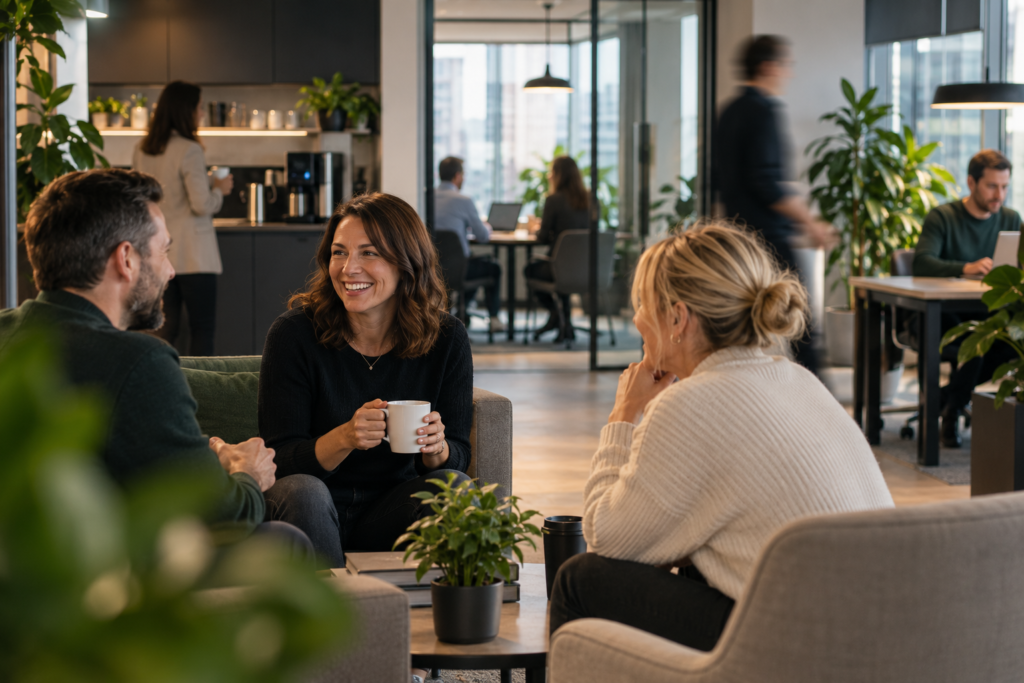
A communal lunch. An interesting speaker. Celebrating somebody’s success properly. Introducing two people because you know they’re working on similar things. Creating a comfortable area where people naturally sit and chat. Putting the coffee machine somewhere that encourages people to bump into one another rather than hiding it away in a corner.
It could be thinking differently about onboarding too.
Starting a new job has always been daunting, but imagine joining an organisation where you might only see your wider team once or twice a week. You can learn the systems remotely. You can complete your induction online. You can read the company handbook.
What you can’t replicate quite so easily is the moment somebody says, “Come on, I’ll show you where everything is”, introduces you to five people and takes you for a coffee.
Those interactions build belonging.
Office Managers have always been brilliant at creating them, often without even realising we’re doing it.
Better systems should give us more time for people
There is another side to this that I’ve been thinking about a lot while building OMOS.
As our workplaces have become more dispersed, the operational side of Office Management hasn’t become simpler. If anything, it’s become more complicated.
We’re managing suppliers, contracts, compliance, Health & Safety, PPM, assets, projects, budgets, workplace requirements and employees who may not even be in the same place as us. Information is spread across spreadsheets, emails, folders, calendars and systems, and a huge amount of an Office Manager’s time can disappear simply trying to keep everything moving.
That’s one of the reasons I created OMOS – the Office Management Operating System.
I wanted to connect those operational areas and make it easier to see what needs attention, what is coming up and what has already been done.
But the bit that excites me most isn’t actually storing the information.
It’s what having better systems can give us back.
Time.
If I’m not spending twenty minutes searching for the latest supplier information, trying to remember when something needs reviewing or manually pulling information together from five different places, I can spend that time doing something that requires an actual human being.
Walking the workplace. Talking to employees. Checking in with a supplier. Thinking strategically about what people need. Planning an improvement. Building relationships. Or simply noticing what’s happening around me.
That’s how I see technology fitting into the future of Office Management generally.
AI, automation and systems like OMOS shouldn’t make Office Management less human. Used properly, they should give us more capacity for the parts of the role that technology can’t replicate.
And hybrid workplaces desperately need those parts.
Don’t guess what connection looks like
One thing I would be careful about is deciding what “connection” should look like on behalf of everybody else.
Not everyone wants after-work drinks. Not everybody loves a huge company social. Some people thrive in busy environments while others find them exhausting. Some want to come into the office specifically to collaborate; others value having a different environment where they can concentrate.
So ask.
Look at attendance patterns. Review how your spaces are being used. Speak to managers and employees. Look at which initiatives people actually engage with rather than continually repeating something because “we’ve always done it”.
And pay attention to the quieter feedback too.
If people keep saying there’s nowhere to have an informal conversation, that’s useful information. If everybody leaves immediately after a company meeting rather than hanging around, why? If one team has built an amazing culture despite only being together twice a week, what are they doing differently?
You don’t necessarily need another employee survey with 47 questions.
Sometimes you just need to talk to people.
The next phase of hybrid needs to be more human
I don’t think hybrid working is going away, and I don’t think it needs to.
It has given people flexibility that many wouldn’t want to lose, opened businesses to wider talent pools and changed our expectations of where work has to happen.
But flexibility and connection aren’t opposites.
The challenge now is making sure we haven’t optimised work so much for efficiency and convenience that we’ve accidentally removed some of the relationships, conversations and spontaneous moments that make people feel part of an organisation.
And perhaps that’s where Office Managers can have some of the greatest influence.
We don’t necessarily write the hybrid policy. We don’t control every manager or decide which days people come in. But we do have an extraordinary view of how the workplace is actually functioning.
We can notice what isn’t working. We can connect people. We can create better spaces. We can challenge assumptions. We can use data alongside what we’re hearing from employees. We can remove operational noise through better systems and use the time we get back to focus on the people occupying those workplaces.
We’ve spent the last few years working out how to make hybrid work operationally.
Perhaps now it’s time to make sure it works humanly too.